REVIEW · RED SEA
Shore Excursion: Safaga Port Overnight Tour to Luxor
Book on Viator →Operated by Love Egypt Tours · Bookable on Viator
Two days in Luxor beats a rushed day. I like that this shore excursion packs East and West Bank highlights into one tight plan, and you get a private Egyptologist to connect the sites. The main drawback is simple: you’re looking at long drive days (around 3 hours each way) plus temple entrance fees on many of the stops.
You’re also buying time and logistics. Instead of worrying about transport and timing from the cruise port, you’re picked up from the Safaga cruise exit door, driven to Luxor in an air-conditioned vehicle, and given a 5-star hotel night with breakfast so you can actually enjoy the ruins without sprinting. Expect an early start and plan to budget extra for entrances where they aren’t included.
In This Review
- Key points to know before you go
- Safaga to Luxor: how the 3-hour drives shape the trip
- Karnak Open Air Museum: 22 temples and the 134-column Hypostyle Hall
- Luxor Temple and the Sphinx Avenue connection
- A 5-star hotel night in Luxor: why it changes everything
- Valley of the Kings: visiting 3 tombs in a sea of 62
- Deir el-Bahari and Hatshepsut’s terraces
- Colossi of Memnon: two giants of Amenhotep III
- Price and logistics: what $699.76 is covering
- Who this Luxor overnight suits best (and who should think twice)
- Should you book the Safaga Port Overnight Tour to Luxor?
- FAQ
- How long is the Safaga Port Overnight Tour to Luxor?
- What time does the tour start?
- Where do you get picked up in Safaga?
- Is transportation included, and is it air-conditioned?
- What meals are included?
- Is there an overnight hotel stay?
- Do I need to pay entrance fees to temples?
- Do you get an Egyptologist guide?
- How large is the group?
- What are the main sights on each day?
Key points to know before you go
- A true overnight in Luxor: one hotel night with breakfast beats the usual day-trip squeeze.
- Private Egyptologist (max 8 people): small group size helps you ask questions instead of just staring.
- East Bank first, then West Bank: Karnak and Luxor Temple on Day 1; Valley of the Kings, Hatshepsut, and Colossi on Day 2.
- Major sites may have entrance fees: Karnak, Luxor Temple, the Valley of the Kings, and Hatshepsut are listed as not included.
- Long drives are part of the deal: transport from Safaga to Luxor takes about 3 hours each way.
Safaga to Luxor: how the 3-hour drives shape the trip
This is a Red Sea cruise shore excursion that trades convenience for travel time. From Safaga port, you’re picked up from the cruise exit door and ride to Luxor by private, air-conditioned car. The transfer is about 3 hours, and the schedule assumes you’re okay spending a chunk of your daylight in the vehicle.
That drive matters, because it affects pacing. On Day 1, you arrive and start right into Karnak. On Day 2, after breakfast you cross to the West Bank and keep moving through several big monuments. There’s no time-wasting buffer, so the best way to enjoy this trip is to go in ready: water on hand, sun protection packed, and a mindset of seeing the essentials rather than lingering like you’re on a weekend in town.
The good news is that the overnight hotel in Luxor offsets the fatigue. When you’re not trying to cram everything back onto a cruise bus the same day, you can view the West Bank stops with a little more breathing room.
Also, a small timing note: the start time is listed as 7:00 am, and transfer durations are approximate and depend on traffic and time of day. For cruise days, that early start is typical—and it’s your friend here. It helps you fit in the major stops without turning the tour into a parking-lot exercise.
A few more Red Sea tours and experiences worth a look
Karnak Open Air Museum: 22 temples and the 134-column Hypostyle Hall
Karnak is where you start to understand why Luxor feels like more than a city. The Karnak Temple Complex is an enormous area of decayed temples, chapels, pylons, and other buildings near modern Luxor. The tour frames it as an open-air museum of sorts, and it specifically calls out two big ideas that help you make sense of what you’re looking at.
First: Karnak contains 22 temples. That doesn’t mean 22 separate quick stops. It means the site sprawls across many structures built over centuries, with additions and changes that reflect different reigns. Second: the Hypostyle Hall is the showpiece. The hypostyle includes 134 columns, which is the kind of number that sounds abstract until you’re standing under them.
What I like about this stop is that it gives you a real anchor for the day. When you know Karnak’s scale and the Hypostyle Hall’s column count, the visuals start lining up. You’re not just walking through ruins; you’re reading a complex that evolved through time—from earlier construction through later periods.
One caution: the tour lists Karnak admission as not included. That means you should expect an extra payment for entry. If you’re traveling with limited flexibility for spending, check whether you’d rather pay entrances and go all in, or choose a shorter, entrance-free style of excursion.
Time on the ground is listed as 2 hours, which is enough for the highlights but still brisk if you stop to read every sign and photo everything.
Luxor Temple and the Sphinx Avenue connection
After Karnak, you move to Luxor Temple on the East Bank. This stop has a different vibe from Karnak. Karnak is big and sprawling. Luxor Temple is more focused, and it’s built around the idea of a sacred center in a city that has served different eras of belief.
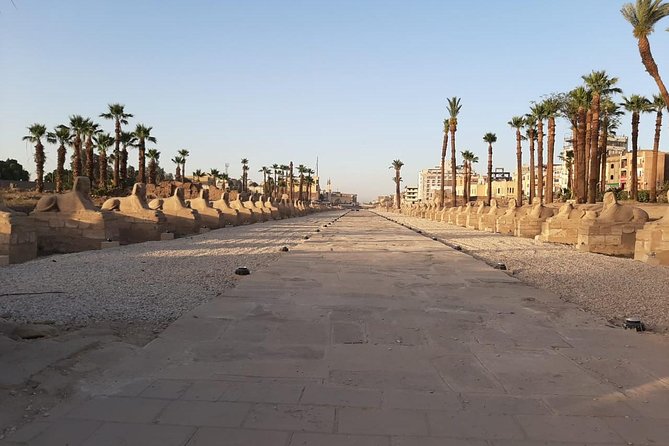
The tour notes that Luxor Temple connects to other monumental spaces via the Sphinx Avenue, a long processional route of sphinxes stretching over 3 km. Even if you don’t walk the full distance, this detail matters. It gives you a sense that the temples weren’t random. They were connected by planned movement and ceremony.
The tour also frames Luxor Temple as evidence of Egypt’s long religious timeline—Pharaonic, then later Christian and Islamic associations. You’ll see that in the way the site is used and layered over time, even in ruins.
Another practical detail: Luxor Temple admission is listed as not included. So, if you’re counting on the tour price to cover everything at the monuments, plan for at least some extra costs here.
Time at Luxor Temple is listed as 1 hour. That can feel short if you’re a slow photographer. But with the Egyptologist guide, you can often get the key points without feeling rushed—especially if the guide is good at turning the site into stories you can picture.
A 5-star hotel night in Luxor: why it changes everything
Day 1 ends with a transfer to your 5-star hotel in Luxor, and you get an overnight stay with breakfast included. This might sound like a luxury add-on, but it’s actually the core value of the whole excursion.
Without the hotel night, most cruise Luxor tours become pure logistics: wake up, drive, hit the sites, and sprint back. Here, the overnight stay makes Day 2 possible without turning it into a scramble. You’ll cross to the West Bank after breakfast instead of doing it on exhausted legs.
It also helps with mindset. The East Bank stops (Karnak and Luxor Temple) are visually stunning, but they’re also intense—hot sun, crowds in key areas, and lots to process. A hotel break gives your brain a pause. Then you return the next day for the Valley of the Kings and the West Bank monuments.
There’s also a comfort factor: the hotel is listed as 5-star and breakfast is included. That removes one more decision from your plate. With meals already handled (lunch on Day 1 and breakfast the next morning), you can focus on the monuments instead of finding food while navigating a tight schedule.
Valley of the Kings: visiting 3 tombs in a sea of 62
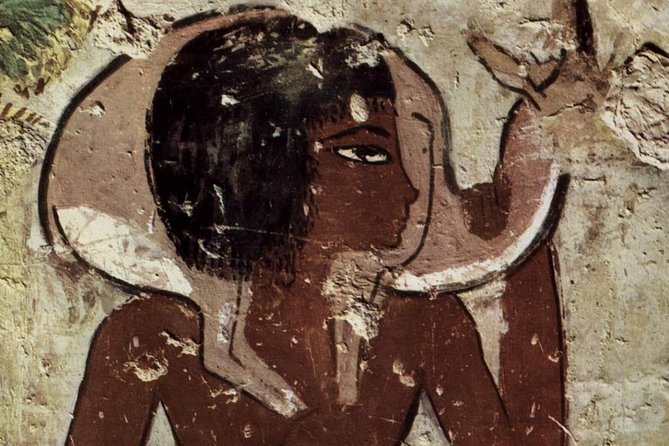
The West Bank is where Luxor starts to feel haunting in the best way. After breakfast, you cross the Nile and visit the Valley of the Kings. The tour states there are over 62 tombs of the New Kingdom, dating roughly from 1550 BC, and you’ll visit 3 tombs.
That “3 tombs” detail is important. The Valley is huge, and tombs are limited by what’s open and what’s worth your time. Visiting only three can be a drawback if you want a long list of tombs. But it’s also how you avoid the common mistake: choosing too many tombs and leaving after a quick glance with nothing sticking.
What I like about doing three with an Egyptologist is that you get context. Each tomb is different in decoration and purpose, and it helps to understand why the selection matters. With an organized visit, you’re less likely to waste time hunting for the best viewing spots or getting stuck behind the wrong crowd flow.
The tour lists Valley of the Kings admission as not included, so expect a separate entrance fee here. Time is listed as 3 hours, which is generous enough for the tomb visits plus time to move between entrances without feeling like a conveyor belt.
Deir el-Bahari and Hatshepsut’s terraces
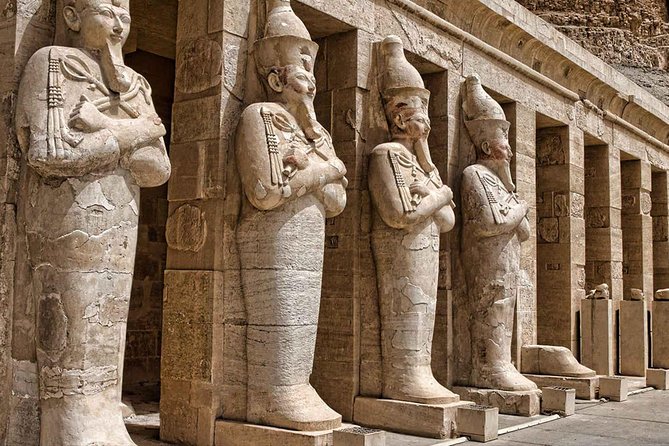
Next is the Temple of Hatshepsut at Deir el Bahari. This is one of those places where the setting does half the work. The temple is built into cliffs and organized into 3 terraces, which gives you a strong visual rhythm even before you focus on inscriptions.
The tour explains that it’s the Mortuary Temple of Hatshepsut, also called Djeser-Djeseru. It was built for the 18th Dynasty pharaoh Hatshepsut and dedicated to Amun, located on the West Bank near the Valley of the Kings. The guide also frames it as an incomparable monument, and it sits near another mortuary temple of Mentuhotep II, which served as inspiration and later a quarry.
Here’s why this stop matters in your day plan: after the dark, enclosed feeling of tomb spaces in the Valley of the Kings, Hatshepsut gives you open-air architecture with perspective. You can see how power wanted to look in stone—aligned with worship and politics—while the terraces lead your eye upward like stage steps.
Time at Hatshepsut is listed as 1 hour, which is usually enough to see the terraces properly without rushing through the key features. Admission is listed as not included, so again, budget for entrances.
Colossi of Memnon: two giants of Amenhotep III
Finish Day 2 with the Colossi of Memnon. These are two huge stone statues of Pharaoh Amenhotep III, and the tour notes you can see ruins of his temple behind them.
There’s a reason these statues are so famous: they’re big even when you’ve seen other big statues. They also sit in a landscape that feels more open than the main temple complexes, so you get contrast. It’s a good final stop because it’s a clean visual moment after tombs and terraces.
The tour gives a strong reference point: the statues have stood since about 1350 BCE in the Theban Necropolis on the West Bank. That kind of time depth makes it feel less like tourism and more like a long conversation across history.
Time is short—30 minutes—and admission is listed as free in the schedule. Even if the time is brief, it’s still worth stepping out and taking in the scale. This is one of those monuments where a quick photo isn’t enough; you need a moment looking up.
Then you drive back to Safaga port for your cruise, with the final transfer listed as about 3 hours.
Price and logistics: what $699.76 is covering
At $699.76 per person for a 2-day package, you’re not buying just sightseeing. You’re paying for setup and comfort.
Here’s what’s included:
- Round-trip pickup and return from Safaga port
- Air-conditioned private transfers throughout
- Private Egyptologist tour guide
- One night at a 5-star hotel with breakfast
- Lunch
- Water and soft drinks during the tour
- Taxes and service charges
What’s not included:
- Entrance fees to temples and sites listed as not included (Karnak, Luxor Temple, Valley of the Kings, Hatshepsut)
- Any extras not mentioned
So is it worth it? For a cruise shore excursion, yes—if your goal is to maximize the major Luxor highlights without the planning headache. If you’re a confident DIY traveler who already knows how to secure reliable transport and timed entries, you might be able to reduce cost. But you’d still likely pay for a guide (or spend a lot of time figuring out what you’re seeing), and you’d still face the long Safaga-to-Luxor transfer problem.
The private Egyptologist adds value because it changes the visit from seeing objects to understanding what you’re seeing. In one referenced experience, the guide Abdul helped keep things enjoyable and offered options to fit the group’s interests and timing. That’s the kind of guide service that often saves you from feeling trapped by a rigid schedule.
Also consider group size. The tour caps at 8 travelers, which keeps the experience more personal than the big-bus model.
Who this Luxor overnight suits best (and who should think twice)
This tour fits best if you:
- Want a two-day Luxor experience without building your own plan
- Care about both the East Bank temples and the West Bank tombs
- Like having an Egyptologist guide to explain what you’re looking at
- Prefer an overnight hotel over a same-day squeeze
You might think twice if:
- You hate early starts and long drives. Starting at 7:00 am and spending around 3 hours each way from Safaga is not gentle.
- You’re trying to minimize extra spending, since several key sites have entrance fees not included.
The small-group size and private guide are real advantages here. They help you manage the crowd energy and ask questions without feeling like you’re at the mercy of a megaphone tour.
Should you book the Safaga Port Overnight Tour to Luxor?
If you’re cruising near Safaga and you want Luxor’s biggest hits with less stress, I’d lean yes. The overnight in a 5-star hotel with breakfast is the swing factor. It turns this from a rushed grab-and-go into a trip where Day 2 on the West Bank feels more human.
Just go in with two clear expectations: entrance fees for several monuments will likely be extra, and the drive from Safaga is long. If you can handle that, you get an efficient, small-group Luxor plan that covers Karnak, Luxor Temple, the Valley of the Kings, Hatshepsut, and Colossi of Memnon with a private Egyptologist to connect the dots.
FAQ
How long is the Safaga Port Overnight Tour to Luxor?
The tour is listed as 2 days (approx.).
What time does the tour start?
Start time is listed as 7:00 am.
Where do you get picked up in Safaga?
Pickup is from Safaga port by the cruise exit door.
Is transportation included, and is it air-conditioned?
Yes. Round-trip transfers are included, and transport is by air-conditioned vehicle.
What meals are included?
Lunch is included, and breakfast is included with your hotel stay.
Is there an overnight hotel stay?
Yes. You stay one night at a 5-star hotel in Luxor, and breakfast is included.
Do I need to pay entrance fees to temples?
Entrance fees are not included for some sites listed in the program, including Karnak, Luxor Temple, the Valley of the Kings, and the Temple of Hatshepsut. Colossi of Memnon is listed as free in the schedule.
Do you get an Egyptologist guide?
Yes. The tour includes a private Egyptologist tour guide.
How large is the group?
The tour has a maximum of 8 travelers.
What are the main sights on each day?
Day 1 focuses on Karnak and Luxor Temple on the East Bank. Day 2 focuses on the Valley of the Kings, the Temple of Hatshepsut, and the Colossi of Memnon on the West Bank.