REVIEW · NAPLES
Naples panoramic tour and Monumental historic center.
Book on Viator →Operated by AmalfiTourCampania · Bookable on Viator
One good reason to do Naples by car first: you get your bearings fast. This Naples panoramic route strings together major sights with on-board commentary, plus big view stops like Castel Sant’Elmo and the Lungomare, so the city clicks into place quickly.
I also like that you’re not stuck in a museum all day. You get a mix of monumental interiors (Royal Palace and Naples’ national archaeology museum) and classic Naples outdoor moments (Posillipo and the sea views), with air-conditioned comfort in between. The one drawback to consider is that entrance tickets are not included, so your final spend will depend on which monuments you plan to enter and how long you stay inside.
In This Review
- Key highlights at a glance
- How this Naples route works in real life
- Royal Palace at Piazza del Plebiscito: the power center of Naples
- Galleria Umberto I: a stylish walk with a complicated past
- Castel Sant’Elmo on Vomero hill: museum + the best views
- Posillipo and the sea: Roman traces and modern coastline
- Lungomare Caracciolo: where Naples breathes
- Piazza del Gesù Nuovo: churches, monasteries, and that Naples flavor
- Museo Archeologico Nazionale di Napoli: Pompeii and Herculaneum without the hassle
- Price and ticket math: is $247.91 worth it?
- The guide style: what to expect from onboard commentary
- Who this tour fits best
- Should you book this Naples panoramic tour?
- FAQ
- How long is the Naples panoramic tour and monumental historic center experience?
- Is the tour offered in English?
- Is pickup available?
- Is this a private tour?
- What’s included in the price?
- Are monument and museum entrance tickets included?
- Which sights are part of the route?
- Does the tour require good weather?
- What’s the cancellation policy?
Key highlights at a glance

- Piazza del Plebiscito Royal Palace: Royal Apartments and the national library in a complex shaped from 1600 to 1858
- Castel Sant’Elmo: Vomero hill views from about 250 m above sea level, with the Naples Novecento museum complex
- Posillipo + Lungomare Caracciolo: sea air and coastline pacing, plus Roman-era traces in the area
- Galleria Umberto I: a “glass-ceiling” walk over a neighborhood that used to be tied to taverns and crime
- National Archaeological Museum: major finds from Pompeii, Herculaneum and Oplontis, plus sculpture and painting
- Chauffeur-style vehicle tour: WiFi onboard, bottled water, and commentary in English, with a private group setup
How this Naples route works in real life

This is a 6 to 8 hour day built around moving between Naples’ best-known viewpoints and key historic sites. You travel by air-conditioned vehicle (very handy in warm weather) and hear commentary on the ride and at the stops, in English.
Most stops are about an hour, with the big time block at the Museo Archeologico Nazionale di Napoli (around 2 hours). That schedule is realistic for a first visit: you see plenty without trying to cram in a full week of museums.
A quick heads-up: the tour price covers transportation and the onboard experience, but you pay monument and museum entries separately. If you’re the type who wants to linger in every room, plan for extra ticket time and money.
You can also read our reviews of more tours and experiences in Naples.


Royal Palace at Piazza del Plebiscito: the power center of Naples
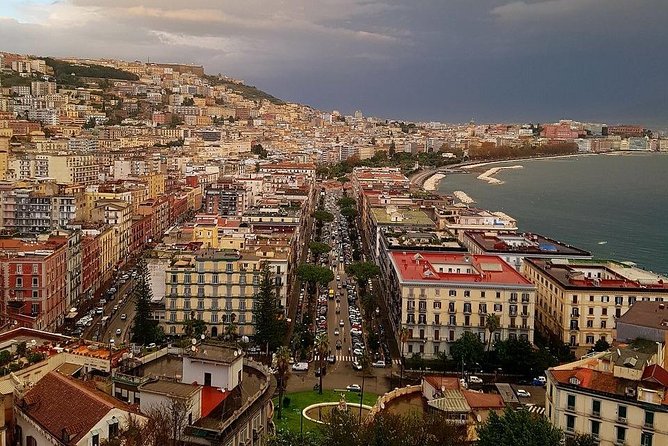
Your tour starts at the Palazzo Reale, the Royal Palace of Naples in Piazza del Plebiscito, one of the city’s grandest squares. This palace complex isn’t just one building. It includes the gardens and the Teatro di San Carlo area, and it sits with major sightlines toward Piazza Trieste e Trento and the neighborhood around Piazza del Municipio and Via Acton.
What makes the palace visit especially worthwhile is the long list of rulers who shaped it. The palace served as the residence of the Spanish viceroys for more than 150 years, then became tied to the Bourbon dynasty from 1734 to 1861. After a break during French domination (with Giuseppe Bonaparte and Gioacchino Murat), it later connected with the Savoys after Italy was unified.
The construction timeline also matters. Work began around 1600 and the palace reached its final appearance in 1858, with major architects involved along the way, including Domenico Fontana, Gaetano Genovese, Luigi Vanvitelli, Ferdinando Sanfelice, and Francesco Antonio Picchiatti. That means you can sense different layers of style as you move through.
Practical tip: since admission isn’t included, you’ll want to decide what you care about most before you go in. If you want the “wow” of royal rooms, focus your time on the Royal Apartments. If you’re a documents-and-architecture type, you’ll appreciate that the palace also hosts the national library.
Galleria Umberto I: a stylish walk with a complicated past
Next up is Galleria Umberto I. The gallery is famous for the impressive covered passageway feel, but the deeper story is what used to be here. Long before the gallery took its recognizable form, the area was already intensely urbanized in the 16th century, with a tangle of parallel streets and short alleys connected from Via Toledo near Castel Nuovo.
This older neighborhood gained a bad reputation because it had taverns and places tied to malfeasance and crime. The area’s notoriety didn’t vanish overnight; it lingered for centuries, and even showed up in earlier writings such as Giambattista Basile’s Le muse napolitane, where women connected to that underworld are referenced.
Why this stop feels good on a tour: you get a quick, low-stress change of pace from palace grandeur. You also get a chance to walk at street level without committing to a full museum ticket. Admission for this stop is free, so it’s a high value add.
If you’re pressed for time, stay alert to architecture details as you walk through. The gallery is an easy place to notice how Naples blends beauty with real street history.
Castel Sant’Elmo on Vomero hill: museum + the best views

Castel Sant’Elmo is the kind of stop that turns a Naples day into a Naples memory. It’s on the Vomero hill near San Martino, and it’s known for both its museum use and its strategic position.
The site name may be medieval, but the location stretches back earlier. It was once called Paturcium, and there was a church dedicated to Sant’Erasmo from at least the 10th century (which later evolved through local naming to Elmo). The bigger fortress structures partly trace back to a Norman observation tower called Belforte.
Here’s the view logic: because it’s about 250 meters above sea level, you can see the city, the gulf, and the roads that link hills around Naples to the urban core. On a panoramic day, this makes it one of the most efficient stops.
Inside, the castle works as a museum complex. It has a permanent museum called Naples Novecento, plus temporary exhibitions and events. It also has a known pop-culture footnote: from 1998 to 2011 it hosted Napoli Comicon, before that festival moved to Mostra d’Oltremare in 2012.
This stop is admission-not-included, so buy your tickets (or plan for them) if you want to go in. If you only do the terrace outside, you’ll still get plenty—but the castle’s museum role is half the point.
Posillipo and the sea: Roman traces and modern coastline

Posillipo is where Naples slows down a touch. Sources trace the promontory to ancient Greek settlement patterns, and later eras left their marks too, including Roman ruins near the shoreline and toward the higher point of the hill. You can also spot remnants tied to a tunnel system—openings that once ventilated a route leading to the residence of Publius Vedio Pollione—plus remnants of an amphitheater.
After ancient times, the area declined as the population consolidated behind fortified walls. In modern history, parts of Posillipo stayed underdeveloped until a major infrastructure shift: construction of the Via Posillipo between 1812 and 1824, starting at the port of Mergellina and running along the coast almost parallel to the shore.
Much of what you see today reflects rebuilding after World War II, but some historic buildings survive, including Villa Rosebery, which is the residence of the President of the Republic.
On this tour, Posillipo is free to visit (no entrance fee listed), which makes it a great fit into a 6-8 hour schedule. It’s the “exhale” stop between monuments.






Lungomare Caracciolo: where Naples breathes

Then you move to Lungomare Caracciolo, the classic sea-front promenade. This part of the day is simple: sea views, sea air, and a chance to walk or just pause and watch the city’s coastline rhythm.
It’s easy to underestimate how much a promenade helps on a historic-center day. After a palace and a castle, your body needs a visual reset. Lungomare gives you that without the friction of ticket lines.
Bring water if you’ll be out longer than planned—this tour includes bottled water, but you can still want extra if the weather turns sunny.
Piazza del Gesù Nuovo: churches, monasteries, and that Naples flavor

Piazza del Gesù Nuovo is a compact stop that packs in big names. The area includes the Chiesa del Gesù Nuovo, the monastery complex of Santa Chiara, and the Cristo Velato located in the chapel of San Domenico Maggiore.
There’s also a local cultural angle baked into how Naples talks about this area. You’ll hear the phrase La Spacca Napoli associated with this kind of neighborhood energy in the city’s storytelling. You don’t need to chase a specific event here to get the feel—you just need to be present in the streets and let the architecture do its job.
This stop is admission-not-included, so be selective. If your priority is to see the churches and interiors, you’ll want to budget ticket time. If you mainly want a feel for the square and its surroundings, you can enjoy it even without entering every site.
Museo Archeologico Nazionale di Napoli: Pompeii and Herculaneum without the hassle

This is the anchor museum stop. The Museo Archeologico Nazionale di Napoli focuses on major finds from across the Vesuvian region, including Pompeii, Herculaneum and Oplontis. It also holds sculptures and paintings—unique pieces that help you understand what daily life, worship, and art looked like before the eruptions.
On this tour, you get about 2 hours here. That’s enough time to do a smart overview and hit several highlights, especially if you don’t try to read everything. If you’re the kind of visitor who wants to linger over every plaque, you’ll probably need extra time beyond the tour’s schedule.
Value angle: this museum stop is the part of Naples that most directly connects with why so many people plan a Vesuvio trip. Even if you never do the ruins, the museum helps you grasp the scale and character of what was preserved and recovered.
Price and ticket math: is $247.91 worth it?
At $247.91 per person, you’re paying for more than just a ride. You’re getting an air-conditioned vehicle, WiFi onboard, bottled water, and commentary in English, plus all fees and taxes related to the tour service.
The catch is that monument and archaeological entries are not included. Based on the stops listed here, you should expect to pay separately for places like the Palazzo Reale and Castel Sant’Elmo, and for the national archaeology museum. Some stops are free (like Galleria Umberto I, Posillipo, and Lungomare Caracciolo), but others are not.
So the value question becomes: will you actually go inside? If you plan to enter the main paid attractions and use the time well, the tour price starts to make sense because you’re saving yourself from piecing together transport and timing across scattered neighborhoods.
If you mostly want to look from outside, you might find the overall cost less attractive, because the driving and guide talk are the core of what you’re paying for, and several major stops require tickets to fully experience.
The guide style: what to expect from onboard commentary
One piece of real-world feedback tied to this kind of product is that the commentary can feel more like general route guidance than an in-depth, room-by-room museum lecture. In one detailed exchange, the provider clarified that this service is a chauffeur-driven tour with general information, not a licensed specialist guide for every stop.
The same exchange also highlighted professional flexibility. The driver described helping with an on-the-fly situation (including walking a passenger back to their ship) while still keeping the tour flow moving afterward.
If you love art history and want deep explanations inside every church and museum room, I’d ask in advance what level of interpretation you’ll get at each stop. You can also consider paying for an additional specialist guide if that option is available through the provider.
Who this tour fits best
This is a good choice if:
- you want a first-time orientation to Naples with a strong mix of viewpoints and major sights
- you prefer guided pacing but still want to decide how long to linger at each stop
- you appreciate a comfortable vehicle day, not a full-on walking-only plan
It might be less ideal if:
- you’re trying to do an entry-heavy museum marathon on a tight schedule
- you want a highly specialized guide for every single interior (you’ll need to plan for that)
Should you book this Naples panoramic tour?
I’d book it if you want a well-paced Naples “greatest hits” day with panoramic stops and a serious museum anchor. The combination of Palazzo Reale plus Castel Sant’Elmo viewpoints, then Posillipo and Lungomare for sea air, and finishing with the National Archaeological Museum is a solid formula.
But don’t ignore the ticket reality. Because entries aren’t included, you should go in with a plan for what you’ll pay to enter, and how long you’ll spend inside each paid site. If that matches your style, the $247.91 per person price is a fair trade for comfort, timing, and a route that helps you understand Naples fast.
If you’d like, tell me your travel month and whether you’re visiting first thing in the morning or later in the day. I can suggest an entry strategy for the paid stops so you don’t end up rushing through the parts you actually came for.
FAQ
How long is the Naples panoramic tour and monumental historic center experience?
It lasts about 6 to 8 hours.
Is the tour offered in English?
Yes, the commentary is offered in English.
Is pickup available?
Pickup is offered, with a meeting point where you display a cartel showing the name of your reservation.
Is this a private tour?
Yes. Only your group participates.
What’s included in the price?
The tour includes air-conditioned vehicle transportation, bottled water, onboard commentary in your agreed language, all fees and taxes, and WiFi on board.
Are monument and museum entrance tickets included?
No. Entrance tickets for monuments and archaeological sites are not included.
Which sights are part of the route?
You visit Palazzo Reale, Galleria Umberto I, Castel Sant’Elmo, Posillipo, Lungomare Caracciolo, Piazza del Gesù Nuovo, and the Museo Archeologico Nazionale di Napoli.
Does the tour require good weather?
Yes. It requires good weather. If it’s canceled due to poor weather, you’ll be offered a different date or a full refund.
What’s the cancellation policy?
Free cancellation is available up to 24 hours in advance for a full refund. If you cancel within 24 hours of the start time, the amount paid is not refunded.