
REVIEW · PORTO
Cruise Shore Excursion – Private Tuk Tuk Tour to the Historic Center
Book on Viator →Operated by Portuk · Bookable on Viator
Porto from a tuk-tuk feels like a cheat code. This private shore tour strings together the city’s best viewpoints and historic stops in a way that buses can’t match. You’ll ride into narrow lanes, then get clear, English narration on Porto’s culture, architecture, and daily life.
I like the private feel and the fact that the tuk-tuk format helps you avoid the steep walking hills. I also like the built-in pacing: a steady chain of stops like Torre dos Clérigos, Livraria Lello, and the river viewpoints, plus a Port wine tasting.
One thing to watch: paid monument entries aren’t included, and the tour is designed for sightseeing first—so don’t expect long shopping breaks or extra time inside churches and museums.
In This Review
- Key Things You’ll Appreciate on This Porto Tuk-Tuk Excursion
- How the Tuk-Tuk Pickup Sets the Tone for a Smooth Shore Day
- Riding Into Porto: Comfort, Cobblestones, and Why Small Vehicles Matter
- Passeio das Virtudes: Douro Views That Anchor the Whole Day
- Maritime-Inspired Sculptures and the City’s Industrial DNA
- Cordoaria Garden (Jardim de João Chagas): More Than a Quick Stop
- The Photo Centre in a Former Prison Building: A Page-Flip in Stone
- Torre dos Clérigos: 240 Steps, Panoramas, and a Modern Twist
- Livraria Lello’s Art Nouveau Face and the Red Staircase Moment
- Igreja do Carmo, Igreja dos Carmelitas, and the Tile-Façade Story
- Fonte dos Leões: A 19th-Century Fountain With a British Connection
- Stock Exchange, Mercado Ferreira Borges, and Praça da Ribeira’s Maritime Spirit
- Iglesia de São Francisco and the City’s Gilded Interior Reputation
- Bridges and River Engineering: Arrábida and the Sense of Modern Porto
- Mosteiro da Serra do Pilar: The Terrace View That Turns Everything Into Context
- Praca da Batalha and the Nearby Theatre Streets
- Bolhão Market and “What If It’s Closed” Reality
- Price and Value: What $106.93 Gets You (and What It Doesn’t)
- Who Should Book This Porto Tuk-Tuk Tour
- Should You Book This Porto Private Tuk-Tuk Tour?
- FAQ
- How long is the Porto private tuk-tuk shore excursion?
- What’s included in the tour price?
- Are monument entrance fees included?
- Does the tour offer pickup from the cruise port?
- Is it a private tour?
- What language is the tour offered in?
- Is there a mobile ticket?
- What if weather is bad?
- Can I cancel for a full refund?
- What cruise details do I need to provide?
Key Things You’ll Appreciate on This Porto Tuk-Tuk Excursion
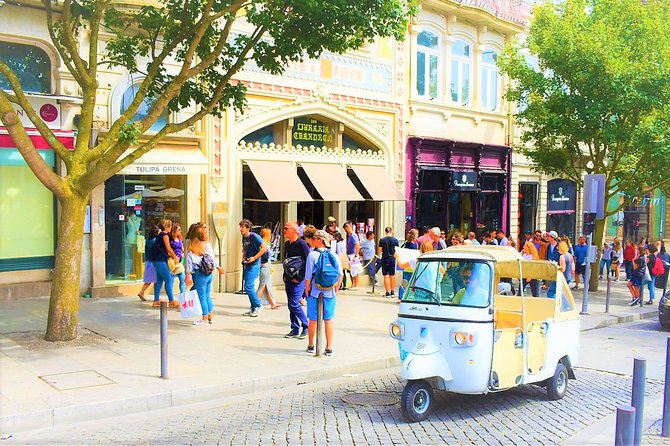
- Narrow-street access: the tuk-tuk can go where bigger vehicles struggle.
- Douro viewpoints built into the route, including Passeio das Virtudes and Serra do Pilar terraces.
- Major Porto icons with context, from Torre dos Clérigos to Livraria Lello and Igreja de São Francisco.
- Sweet timeline for a shore day, about 3 hours 30 minutes with tight stop durations.
- Port wine included as a real “you’re in Porto” moment, usually at a viewpoint rather than a formal bar stop.
- Free outdoor sights are frequent, but inside entries require extra tickets.
How the Tuk-Tuk Pickup Sets the Tone for a Smooth Shore Day
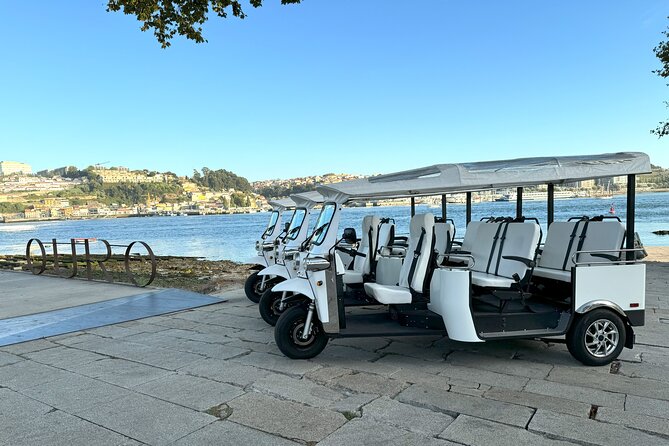
Your day starts with pickup near the cruise area—specifically from the main gate at Leixões Port, Matosinhos Port, and Doca Norte. The tour starts no later than 1 hour after your ship arrives, and the guide picks you up at the pier outdoor gate.
This matters because Porto is hilly, and you don’t want to burn half your limited day just finding people and vehicles. The tuk-tuk helps you get moving quickly once you’re onboard. It’s also a true private tour in setup (minimum 2 people per booking), meaning your guide can steer the day around your comfort level and pace.
One practical note from real-world experience: some people found the pickup pin location on maps off by a bit. If you can, walk to the outdoor gate area your driver/guide is using, not just the nearest map marker. Also, the whole tour assumes good weather, so if conditions are rough, you may need to switch dates or receive a refund.
Riding Into Porto: Comfort, Cobblestones, and Why Small Vehicles Matter
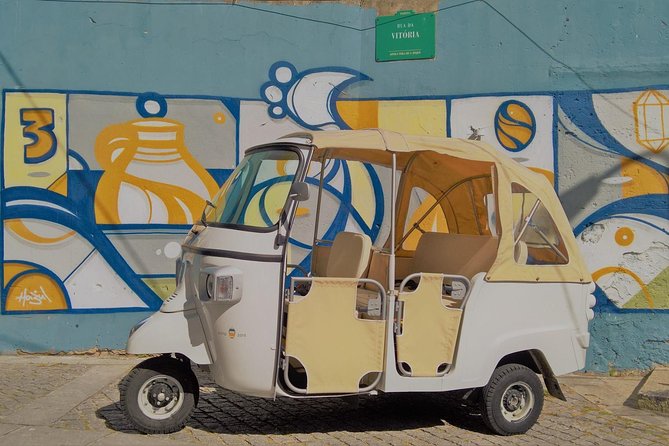
Porto streets look charming in photos—and many are also cobbled and uneven. That’s part of the charm, but it’s also why the tuk-tuk ride is worth planning for.
In the tour context, the tuk-tuk is usually comfortable for couples and small groups, and it can be a great alternative to steep walking. But it’s not a magic carpet. If your group is larger (for example, 3 people), you may feel cramped depending on the exact tuk-tuk model. One warning that pops up is that cobblestones can feel bumpy, so if you have back issues or you’re sensitive to jostling, keep that in mind and sit where you feel most stable.
The upside: because you’re not walking every hill, you’ll likely cover more ground without getting wrecked by elevation. For a shore excursion, that’s huge.
Passeio das Virtudes: Douro Views That Anchor the Whole Day
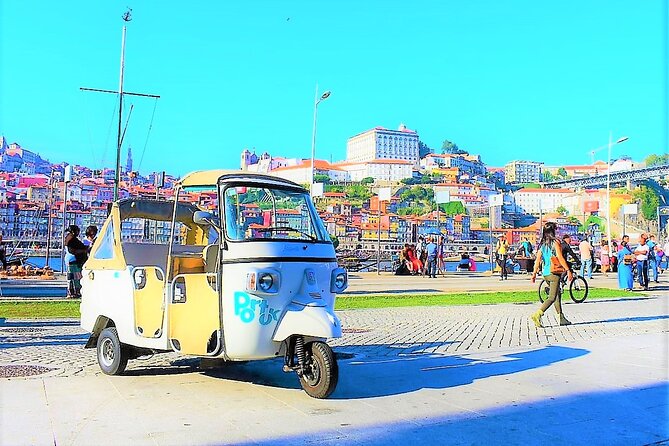
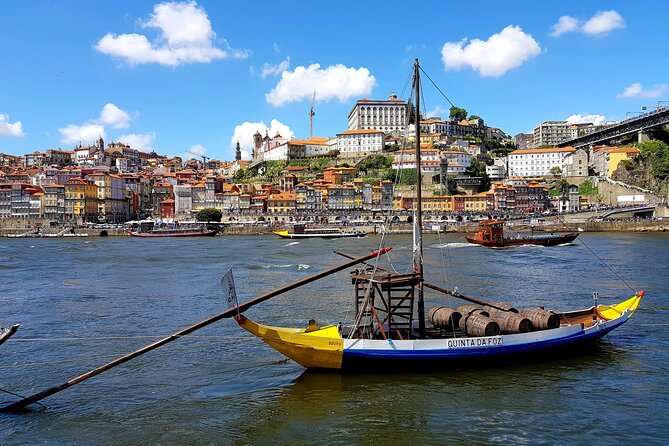
A major early payoff is Passeio das Virtudes, where the lane gives you wide views over the Douro River and down toward the river’s mouth bar. In the foreground you’ll spot the Fountain of Virtudes, and you can see the terraces stepping down toward São Pedro de Miragaia.
This stop works as an “orientation moment.” Once you’ve seen how Porto stacks along the river, every later church, square, and bridge makes more sense. You also get a useful sense of scale: the river isn’t just scenery—it’s the reason Porto’s history, industry, and even architecture concentrate here.
Expect the viewing time to be short, but it’s still long enough to take photos and orient yourself mentally. If you want a smooth transition to later stops, use this pause to decide what you’d actually return to after the cruise.
Maritime-Inspired Sculptures and the City’s Industrial DNA
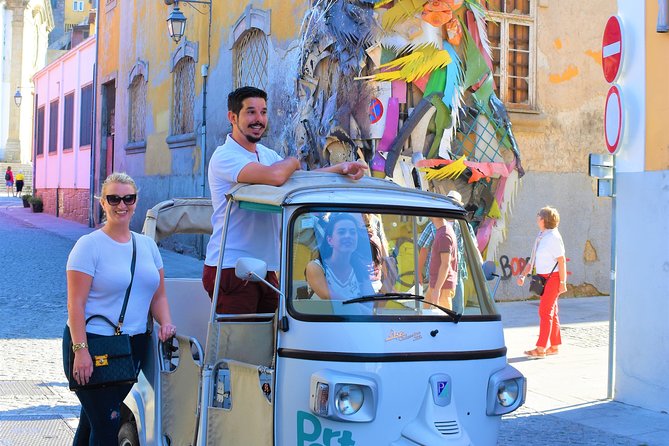
Before you get fully into the classic center, the tour makes room for Porto’s seafaring and industrial heritage. You’ll see a sculpture designed with maritime storytelling—support poles painted to resemble local smokestacks and lighthouses, plus a net structure referencing the fishing industry.
That kind of detail is easy to miss if you only do a “greatest hits” walking loop. The tuk-tuk day gives you little visual cues like this, which makes Porto feel less like a postcard and more like a working port city with deep roots.
If you like art that explains place—rather than art that’s purely decorative—this is the kind of stop that quietly makes the rest of the route richer.
Cordoaria Garden (Jardim de João Chagas): More Than a Quick Stop
A standout green break is Cordoaria Garden, also known as Jardim de João Chagas. This garden ties directly to Porto’s rope-making past, since rope makers stayed in this area for roughly 200 years. The garden project is linked to the German landscaper Emile David (built in 1865/1866).
What I like about this stop is that it’s not just “nice views.” It’s a mix of architectural charm, period landscaping, and small surprises. Statues include Ramalho Ortigão and António Nobre, and the garden also features later sculptures such as a Juan Muñoz work titled O rapto de Ganímedes. During Porto’s cultural years, the garden also underwent remodelling.
Practical tip: there’s a miniature golf course here, and sometimes you’ll hear about concerts linked to the bandstand. Even if you don’t catch events, it’s a pleasant reset from streets and churches.
The Photo Centre in a Former Prison Building: A Page-Flip in Stone
Another high-value stop is the granite polygonal building originally from 1582, rebuilt in 1767 in a neo-classical style. It’s known today as the Portuguese Centre for Photography, restored in 1999–2002 under Eduardo Souto de Moura and Humberto Vieira.
Here’s what makes it interesting: the building’s design is tied to power and movement. It has 103 windows and a court sector entrance on Rua de São Bento da Vitória, plus another façade that historically relates to prisoner movement. Porto history is personal too—people like writer Camilo Castelo Branco and the famously named Zé do Telhado were kept there.
Even if you don’t go inside, this is a smart stop to include on a shore day because it explains why Porto’s architecture feels dramatic and slightly theatrical. It also gives you a “Porto isn’t only pretty” perspective.
Torre dos Clérigos: 240 Steps, Panoramas, and a Modern Twist
Torre dos Clérigos is one of Porto’s most emblematic monuments. It’s baroque, built in the first half of the 18th century by Nicolau Nasoni, and it’s famous for the 240-step climb to a panoramic view over the city and the Douro.
The key practical point: the tower entry is not included in the tour’s monument admissions. Still, the stop itself is worth making because the tower’s silhouette is instantly identifiable, and the viewpoint angle helps you understand Porto’s river layout.
One modern feature is worth knowing: there’s a multi-sensory approach connected to the climbing experience that simulates parts of the ascent and is designed to be accessible. If you’re short on energy, or if you just want context, this can be a good way to get the story even if you’re not planning to go all the way up.
If you do plan to climb, go with the mindset that it’s the “main event” of this part of the day, not a quick photo stop.
Livraria Lello’s Art Nouveau Face and the Red Staircase Moment
Next up is Livraria Lello, a library housed in a building inaugurated in 1906. The exterior is Art Nouveau with neo-Gothic details, and inside you’ll find painted plaster that imitates wood plus a dramatic staircase.
What makes this stop special is how it mixes materials and eras. One of the highlights is a huge stained-glass skylight featuring the library’s monogram and motto Decus in Labore. The staircase is also notable for being among the early reinforced concrete works in Porto, linking the ornate interior to industrial-era engineering.
Like the tower, monument entrance tickets are not included, so you’ll need to plan ahead if you want to go inside. A practical rule for your shore day: if you really care about entering, sort your ticket plan in advance so you don’t lose valuable tour time to queues.
If you’re not entering, still take a moment to look at the façade and stair design from outside. It’s one of those places where the building itself sells the experience.
Igreja do Carmo, Igreja dos Carmelitas, and the Tile-Façade Story
Porto’s church stops here aren’t random. They’re chosen because they show different sides of the city’s artistic language.
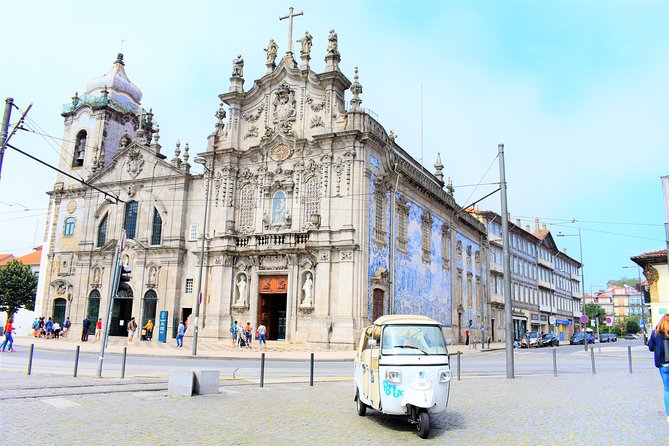
- Igreja do Carmo (second half of the 18th century) is a remarkable example of Porto rococo architecture. In 1912, its lateral façade was covered with tiles designed by Silvestre Silvestri, depicting figurative scenes tied to the cult of Nossa Senhora. This is a national monument.
- Igreja dos Carmelitas goes back further, with a 17th-century church and a classical façade dating to the 1850s, often attributed to Nicolau Nasoni. The interior altarpiece is Porto rococo style and is described as stylistically revolutionary. This is also a national monument.
A practical thing to know: Igreja do Carmo’s entrance isn’t included, and not every interior will fit neatly into short stop time. So treat these stops as architecture moments—look for façade details, tilework, and exterior carvings. If you want interiors, that’s a “yes, I will pay and I will plan time” decision.
Fonte dos Leões: A 19th-Century Fountain With a British Connection
Between big monuments, you’ll also see Fonte dos Leões (Fountain of the Lions). It’s a 19th-century fountain built by a French company and cast at the Val d’Osne foundry in France. The fountain is a copy in most parts of a fountain in Leicester, England.
This is a small stop, but it’s a nice example of how Porto connects to broader European influences. For me, it’s also a helpful breather. You get color and detail without the “line and ticket” friction that comes with some of the other sites.
Stock Exchange, Mercado Ferreira Borges, and Praça da Ribeira’s Maritime Spirit
If you’re hungry for Porto’s “river-to-trade” story, this stretch hits it.
You’ll pass by:
- Praça da Ribeira, an old square with medieval origins and a long commercial tradition, with modern nightlife energy. There’s also the Monument to the Infante D. Henrique, built for the 5th centenary of his death, with construction started in 1894 and completed in 1900.
- Palácio da Bolsa (Stock Exchange Palace), designed in neoclassical style in 1842 and tied to the Commercial Association of Porto. Its major highlight is the Arabian Room, but since monument entrances aren’t included, you’ll be looking from outside unless you add your own ticket.
- Mercado Ferreira Borges, built in 1885 in iron architecture. It later shifted from a market to an entertainment venue, with Hard Club located there today.
A key practical detail: Praça da Ribeira is described as closed to vehicles. That’s good for atmosphere and walking, but it also means your tuk-tuk will need to do its best for drop-offs and photo angles. The guide timing matters here, so pay attention when they suggest where to stand for photos.
If you want to return after your tour, this is the area that makes the strongest “post-cruise evening plan.”
Iglesia de São Francisco and the City’s Gilded Interior Reputation
Igreja de São Francisco is Porto’s most important Gothic temple, with construction beginning in the 14th century. The interior is celebrated for gilded Baroque work from the 17th and 18th centuries—so much that it’s been described as the Church of Gold. You’ll also hear about the Tree of Jesse and the catacombs.
This is another stop where you should decide what you want:
- If you’re mainly there for the exterior and quick interior glance, you’ll still get a sense of its importance.
- If you want to go deep into gilded craftsmanship and catacomb history, plan for paid entry time. Monument entrances aren’t included, so the tour may not give you enough minutes for full immersion.
Even with limited time, this is one of the best stops to “feel Porto’s ambition.” The church interior isn’t subtle, and it’s one of the reasons this city became a big name in European art and trade.
Bridges and River Engineering: Arrábida and the Sense of Modern Porto
Porto’s skyline isn’t just old stone. This tour includes major bridge engineering that shows how the city modernized while staying tied to the Douro.
You’ll see the Arrábida Bridge, an arch bridge of reinforced concrete carrying six traffic lanes between Porto and Vila Nova de Gaia. It was concluded and inaugurated by 22 June 1963, designed by Portuguese engineer Edgar Cardoso, and at the time had the largest concrete-arch main span of its type in the world (270 meters).
Later, you’ll also get a look at another major river crossing described as an iron bridge planned by Teófilo Seyrig (disciple of Eiffel) inaugurated in 1886, with two overlapping iron decks. Today the upper deck carries the metro.
These bridge stops are great if you like engineering or if you simply want to understand why Porto feels both historic and fast-moving.
They’re also a useful visual “connective tissue” between old churches and modern neighborhoods.
Mosteiro da Serra do Pilar: The Terrace View That Turns Everything Into Context
A true payoff is Mosteiro da Serra do Pilar, a World Cultural Heritage site started in 1538 and finished around 1670. The church is circular with a dome, and the cloister is circular with 36 Ionic columns, described as the only example of its kind in Portugal.
History here isn’t just decorative. During the Civil War (1832–1834), the liberal army used the monastery, leading to disrepair. It was later recovered through the creation of a Royal Brotherhood in 1834 and then a group of friends in 1925.
The best part is the terrace. From up there you can see nearly the whole Porto–Gaia riverfront: the historic center, the cathedral area, D. Luís I bridge, and even the Arrábida Bridge. In the other direction, you can see Fontainhas and the São João bridge.
It’s the kind of view that makes you say, okay, now I get the city’s geography. It’s also a great stop for photos, since the vantage point gives depth along the river rather than just a flat street scene.
Praca da Batalha and the Nearby Theatre Streets
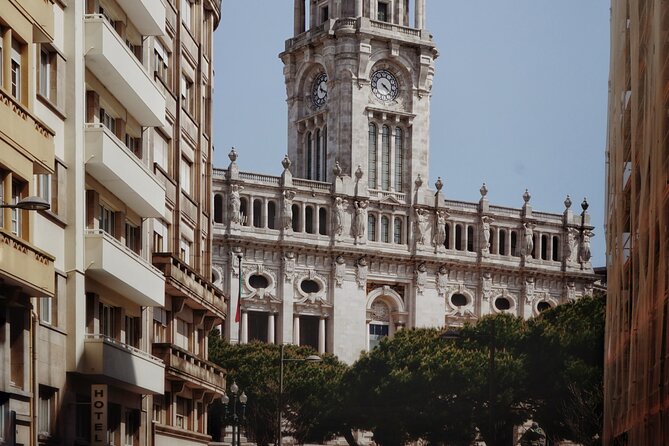
You’ll spend time at Praca da Batalha, a square associated with city transformation after old walls were demolished. The square is dominated by the monument to D. Pedro V since 1866. Also nearby you’ll find São João National Theatre and Cine-Teatro Batalha.
The tour also includes the São João National Theatre building constructed in 1910 on older burned ruins. The façade includes stylistic emblems tied to pain, quality, hate, and love. The overall aim was to encourage theatre access and present works across genres.
If you like architecture, this is a satisfying pause between older churches and river viewpoints. It’s also a good spot to breathe and reset your feet before the last pushes toward markets and additional church details.
Bolhão Market and “What If It’s Closed” Reality
The tour includes the Bolhão Market, Porto’s most famous market. It dates to 1850, has a two-floor structure with neoclassical architecture, and is organized into specialized sections like fish, butcher counters, green grocers, and florists.
But here’s the catch: it’s currently closed for refurbishment. So treat this as an exterior stop and a photo opportunity, not a shopping mission.
The tour’s design works best when you think like this: Porto has more to offer than one market building. If Bolhão is shut during your day, you can still use the time to explore adjacent streets, eat nearby, and come back later if your schedule allows.
Price and Value: What $106.93 Gets You (and What It Doesn’t)
At about $106.93 per person for roughly 3 hours 30 minutes, the main value is not just the route. It’s the combination of:
- Private tuk-tuk transport that saves uphill walking time
- Driver/guide and live commentary in English
- A local guide
- A Port wine glass included during the experience
What’s not included is monument entrance tickets. In practice, that means Torre dos Clérigos and Livraria Lello require extra planning if you want to go inside. Churches also fall into this bucket since monuments entrances aren’t included overall.
So I’d judge the price based on your intent:
- If you want a fast, guided orientation through Porto’s key sights, this is a strong deal.
- If you want deep time in several paid interiors, you’ll need to budget for entrances and possibly adjust expectations for how much you can fit in one shore day.
Also, there’s a real-world caution: while the tour is marketed as private, one reported experience described having to share the tuk-tuk due to overbooking. If “private only” is non-negotiable for you, confirm directly that your vehicle is reserved strictly for your party.
Who Should Book This Porto Tuk-Tuk Tour
This tour makes sense if:
- You only have one day in Porto and want a high-coverage orientation.
- You want a mix of views, churches, and city context rather than just one neighborhood.
- You don’t want to fight steep hills for hours on foot.
It may be less ideal if:
- You need lots of shopping time. The schedule is sightseeing-focused.
- You have trouble with bumpy cobblestones or you’re very sensitive to tight seating.
- You plan to enter multiple paid monuments and want long, slow interior time.
Should You Book This Porto Private Tuk-Tuk Tour?
If your goal is a smart, time-efficient Porto introduction with river views and major monuments in one go, this is a good bet. The tuk-tuk format makes the day feel lively and practical, and the included Port wine adds a classic Porto touch without turning the day into a bar crawl.
I’d book it if you’re:
- traveling with limited time from a cruise stop
- happy to see paid interiors as bonus add-ons rather than guaranteed deep visits
- looking for a guide-led route that helps you decide what to revisit later
I’d skip or swap tours if your top priority is long shopping breaks, or if you’re counting on several “must enter” sites without extra planning.
FAQ
How long is the Porto private tuk-tuk shore excursion?
It’s approximately 3 hours 30 minutes.
What’s included in the tour price?
The tour includes the driver/guide, live commentary on board, a local guide, and an alcoholic Port wine glass.
Are monument entrance fees included?
No. Monument entrances are not included.
Does the tour offer pickup from the cruise port?
Yes. Pickup is offered from the main gate at Leixões Port, Matosinhos Port, and Doca Norte.
Is it a private tour?
Yes, it is listed as a private tour/activity where only your group participates. A minimum of 2 people per booking is required.
What language is the tour offered in?
English.
Is there a mobile ticket?
Yes, the tour is listed as using a mobile ticket.
What if weather is bad?
This experience requires good weather. If it’s canceled due to poor weather, you’ll be offered a different date or a full refund.
Can I cancel for a full refund?
Yes. You can cancel up to 24 hours in advance for a full refund.
What cruise details do I need to provide?
Cruise ship passengers must provide the ship name, docking time, disembarkation time, and re-boarding time at the time of booking.
You Might Also Enjoy
 Classic Private 2-Day Shore Excursion Tour Package to Beijing from Tianjin Port
 Kusadasi Shore Excursion: Private Tour to Ephesus including House of Virgin Mary and Temple of Artemis
 Blue Hole Waterfall & Beach Break Shore Excursion from Port of Falmouth
 Olden Shore Excursion: the Amazing Briksdal Glacier